Tegaki: Short Film Release
Tegaki
Tegaki is a completed short research and development project from Marunouchi Animation Labs. After pausing 5RPS production to make the film, we are returning to the work-in-progress feature.

Tegaki means “hand-drawn,” but the completed short does not treat that idea as a simple argument for or against artificial intelligence. It follows Nozomi, an overworked animator, and Mia, her childhood friend and a machine-learning researcher, as a private experiment brings automation, creative labor, and consent into the same production space. Their disagreement is also a relationship: Mia sincerely believes new tools can help, while Nozomi experiences the same tools as a threat to the work and identity she has spent years building.
Tegaki was completed as a short research and development project by Marunouchi Animation Labs. The production tested a hybrid process in which screenplay, storyboards, animatic, generated material, compositing, and manually built screen graphics each served a distinct function. Production on 5 Requests Per Second was paused temporarily while this experiment was completed; with Tegaki finished, work on the work-in-progress feature has resumed.
Reworking an earlier film
The short grew from a feature screenplay developed in late 2023 and early 2024. That earlier project centered on an overworked animation director who had moved from engineering into animation, and on the friendship that remained with an engineer as the director’s creative freedom was gradually narrowed by management and marketing. The short keeps the underlying pressure but gives it a more concentrated form: engineering and animation become a conflict about automation, authorship, creative labor, and consent.
Tegaki is not a miniature version of the earlier feature, but a new arrangement of selected character designs and backstory for a production environment already changed by AI.
A workspace as a story map
The portrait poster gathers those pressures into one production environment. Nozomi and Mia sit within a workspace of boards, drawing tools, interface windows, and translucent generation systems. The arrangement is an editorial reading of the film rather than a literal frame: the hand-drawn and computational elements occupy the same visual field, making the relationship between them impossible to separate.
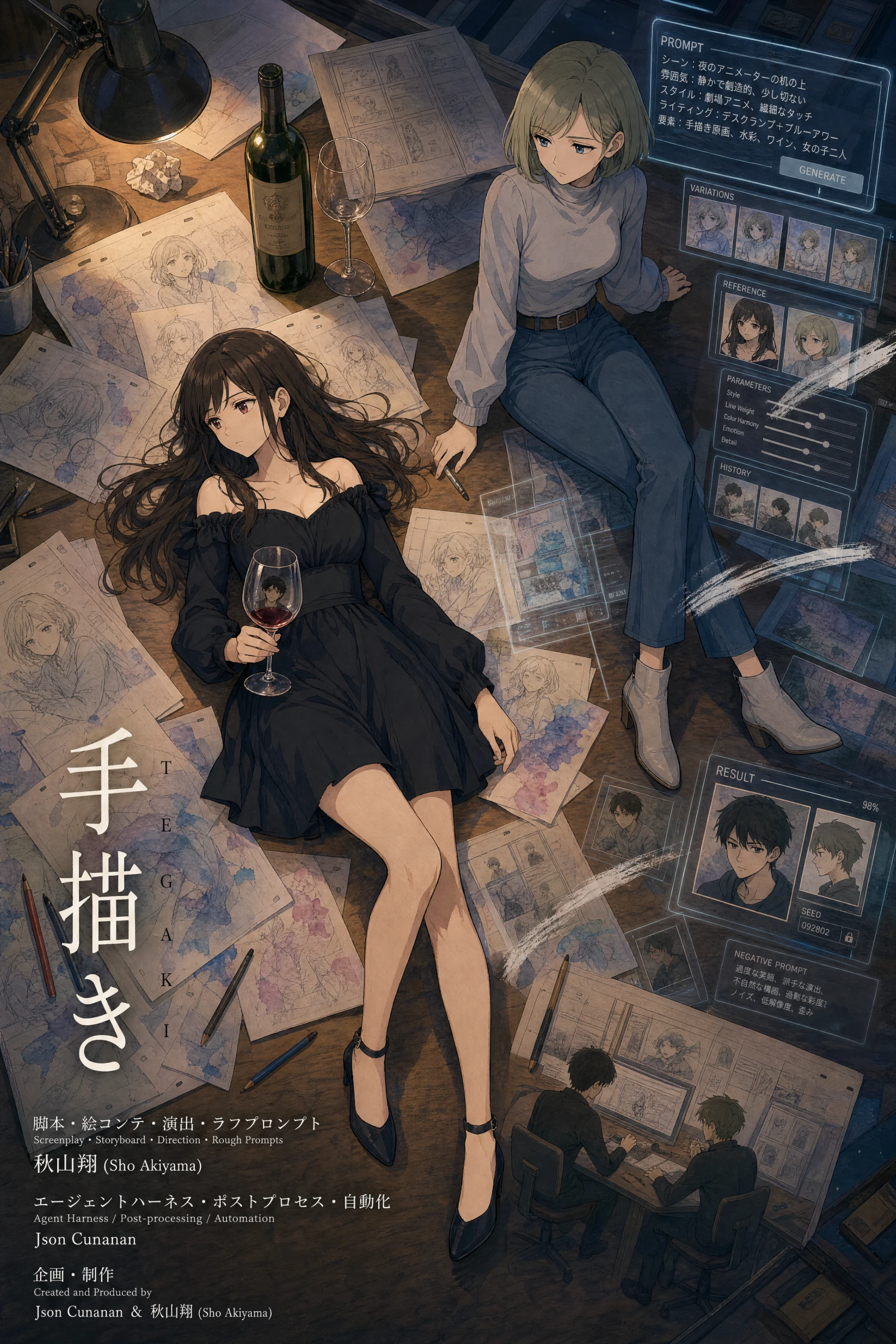
The poster works as a compact statement of the production question. It places a filmmaker and researcher in a shared space where tools, labor, and responsibility overlap. Technology may accelerate an image, but the surrounding decisions still have to be designed, timed, and owned.
Designing two positions
The character sheets establish more than appearance. Turnarounds lock silhouette, proportion, costume, and hair across angles; expression rows define an acting range for a technically varied production. Nozomi and Mia read as a pair while carrying different relationships to work, tools, and control.
Nozomi: craft under pressure
Nozomi is a woman in her late twenties and an animator/animation director at a small, struggling studio in Nakano. She is highly skilled but overextended: her work includes directing, retakes, and correcting junior animators’ drawings, while her personal livestreams preserve a more direct connection to drawing. Her long espresso-brown hair, wine-red eyes, black off-shoulder dress, and controlled dark silhouette give her a composed public outline. The expression sheet then opens that outline to fatigue, warmth, concentration, and defensive control.
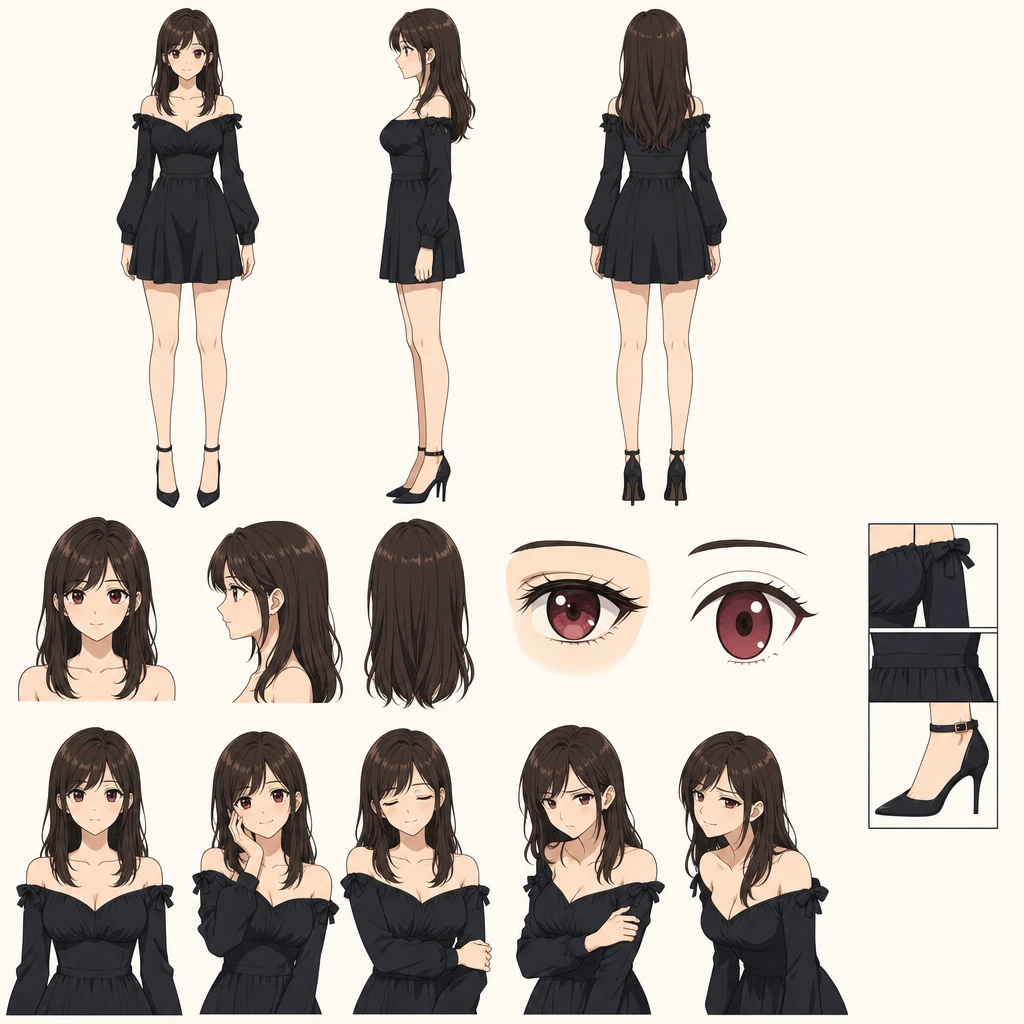
The contrast between polished presentation and visible exhaustion shapes the staging. A correction mark on a face outline or eye position is an ordinary studio action and a reminder of the knowledge behind her hand. Her resistance is attached to livelihood, training, and the fear that years of judgment may no longer be legible as labor.
Mia: a practical counterposition
Mia is Nozomi’s childhood friend and a machine-learning researcher in her late twenties. Her practical olive bob, pale high-neck top, slate-blue trousers, belt, and ankle boots create a grounded silhouette with open, mobile expressions. The design makes her approachable and technically minded without turning her into a visual emblem of “the machine.” She is a person whose confidence in tools comes from wanting them to be useful.
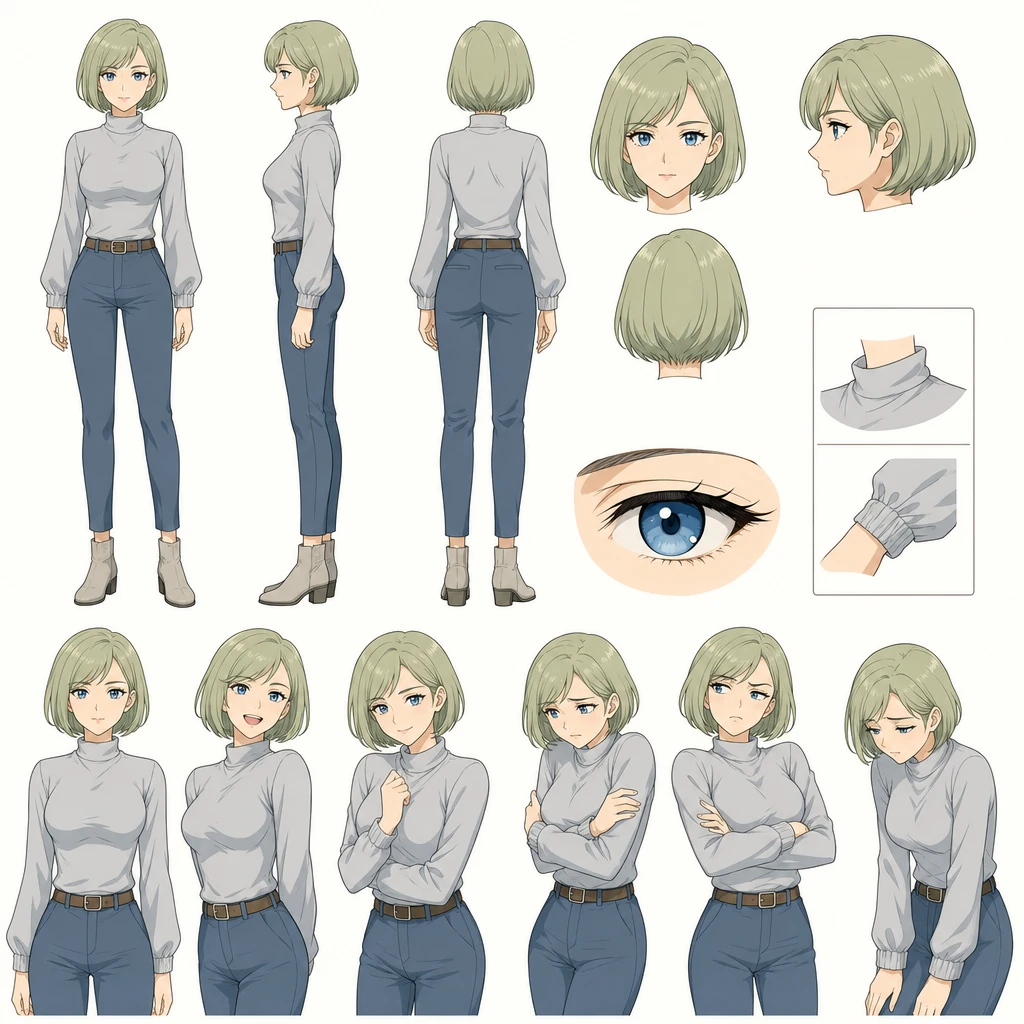
Mia’s private experiment with Nozomi’s drawings is unauthorized, and the film takes the consent conflict seriously, but she is not presented as a villain. Her directness and warmth make the disagreement more difficult: friendship permits familiarity while also creating the conditions for a boundary to be crossed.
A film inside the film
Nozomi eventually turns her own experience into another film. Its male protagonist makes the nested repetition visible: the short follows an animator who makes a film about a person facing the same accusation from a different position. These are parallel studies for the film-within-the-film, not casual alternates.
A parallel Nozomi study
The male Nozomi study carries forward the relationship between a dark, controlled silhouette and a more exposed expression range. It provides the inner film with a recognizable structural echo while changing the social reading of the protagonist. The design remains connected to Nozomi’s original visual logic without pretending that the two characters occupy the same role.
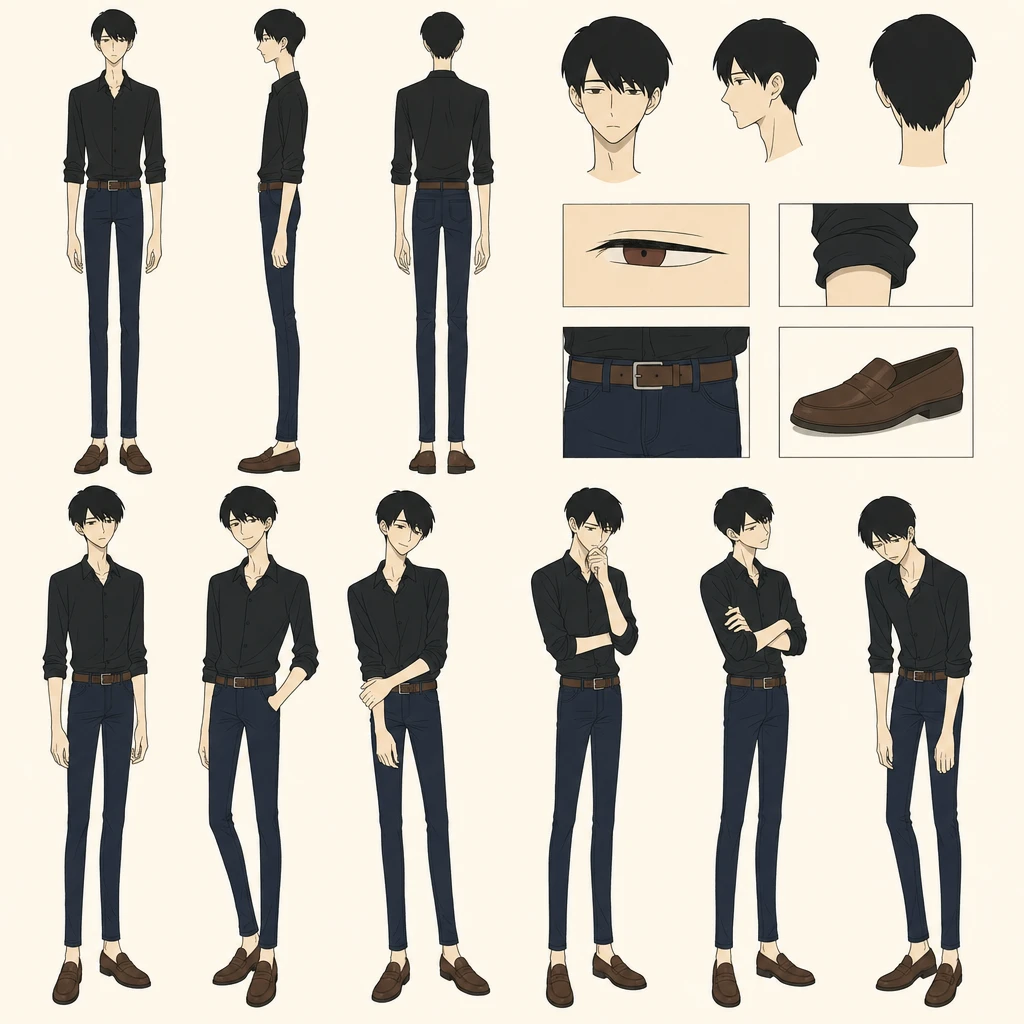
The repetition is therefore visible in the transition from one design system to another: the audience recognizes the relationship while noticing that the inner film has altered its point of view.
A parallel Mia study
The male Mia study performs the same operation for the other side of the relationship. It retains the idea of a practical, accessible counterposition while developing Mia’s male counterpart as the second principal design in the inner film. Together, the two studies establish a paired design language for a story that repeats the outer film’s questions from inside it.
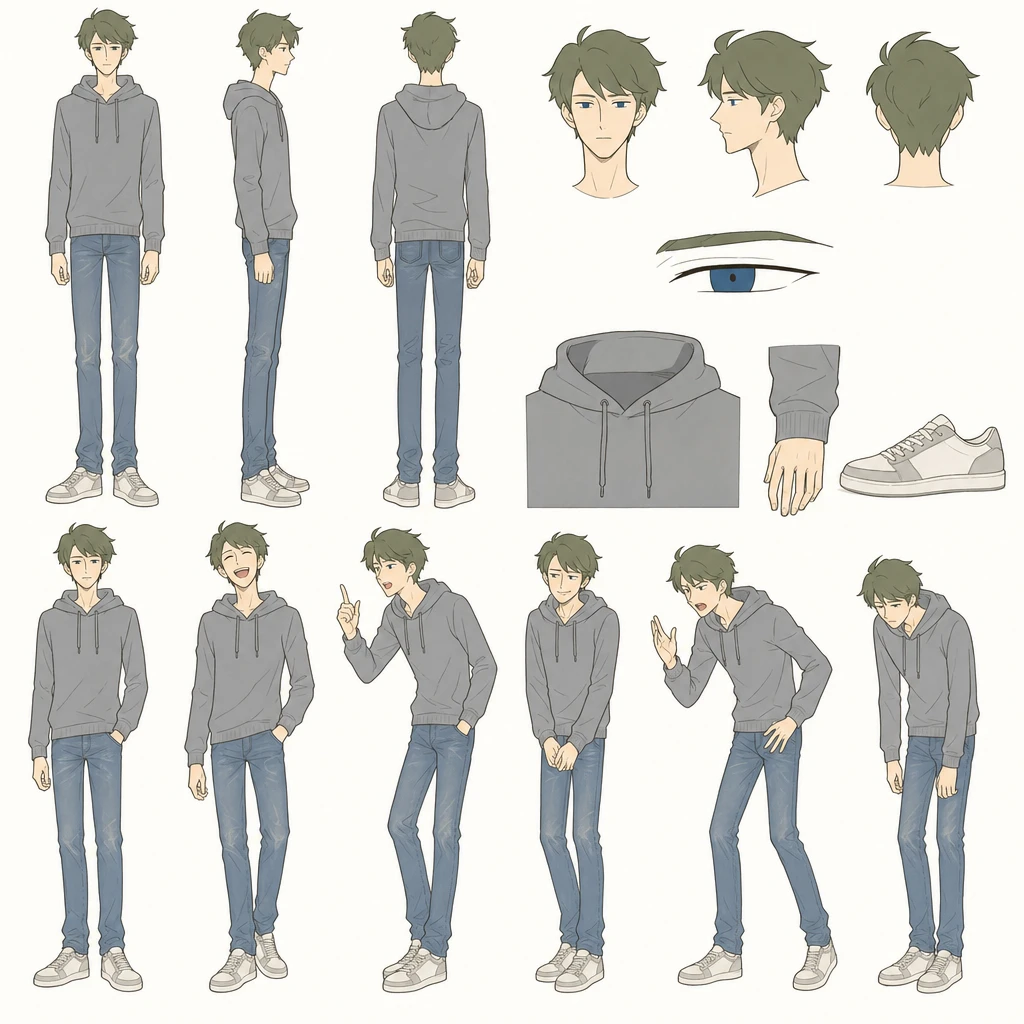
Nozomi does not escape the original conflict by making another film; she carries it into a new set of bodies, choices, and production conditions.
The studio around them
The surrounding staff keep the story from becoming only a two-person debate, establishing different relationships to craft and institutional pressure.
Rika: ordinary work continuing
Rika is a more experienced studio animator and coworker. She is protective of traditional craft and skeptical of generative AI, but she is also exhausted by the same production pressures affecting everyone in the room. Her brighter, fashion-conscious silhouette and expressive acting range give the studio a social energy that exists alongside the crisis.
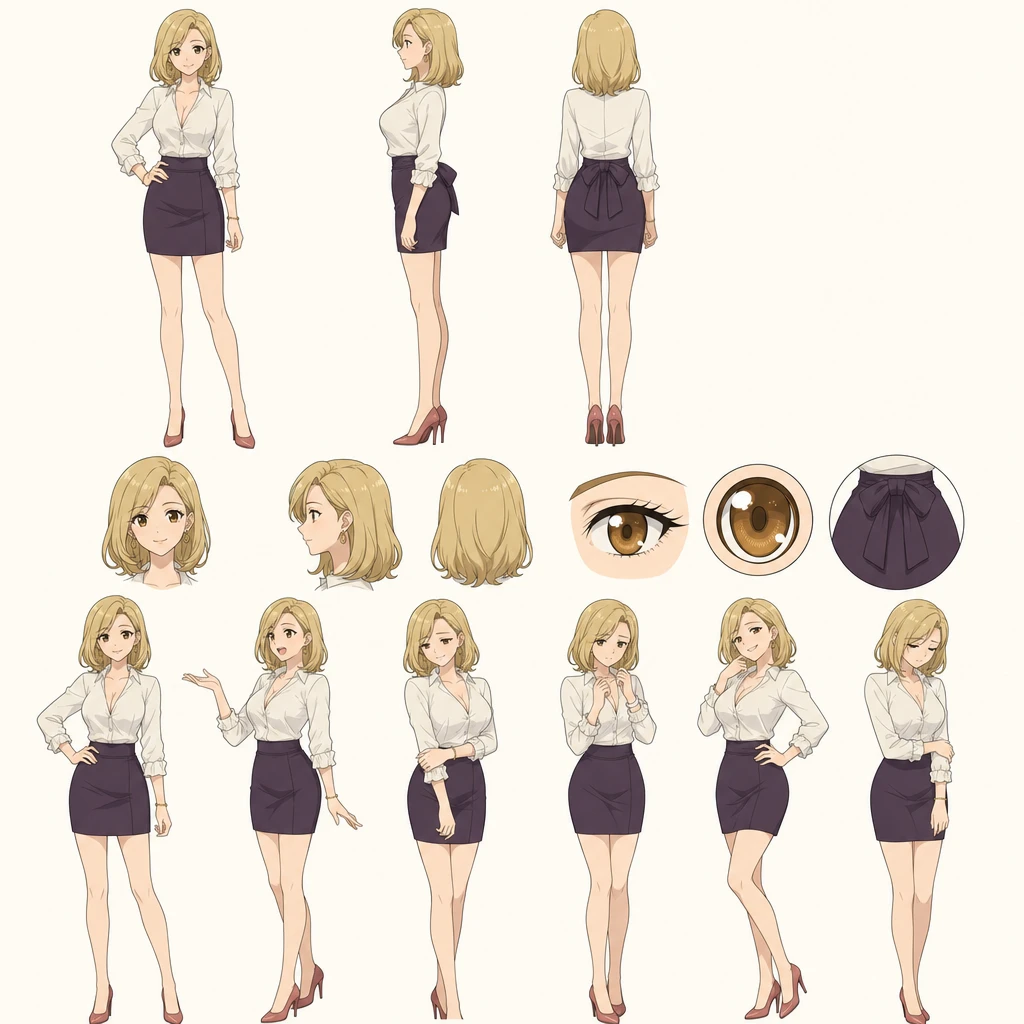
In the final screenplay, Rika’s brief invitation to lunch is deliberately small: ordinary studio life continuing while Nozomi’s professional and public identity begins to fracture.
Yui: fundamentals passed by hand
Yui is a junior animator whose work Nozomi corrects directly. Her careful, soft silhouette supports a character who is conscientious and still developing her confidence. The design sheet’s tidy organization reflects the practical need for a junior artist to remain readable across corrections, revisions, and short production schedules.
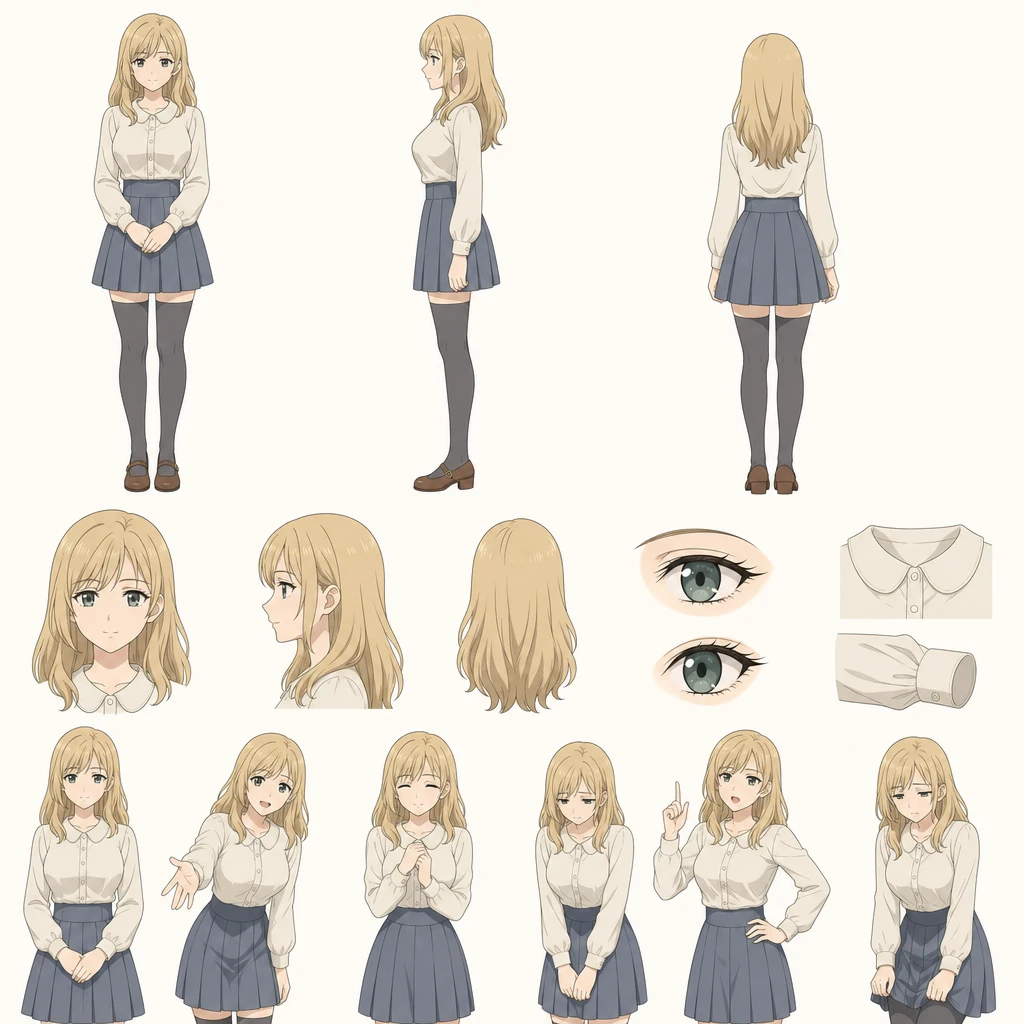
The screenplay makes the act of teaching concrete. Nozomi corrects the face outline and the placement of the eyes, drawing a second version beside Yui’s work so the difference can be compared immediately. It is a small exchange, but it shows how animation knowledge moves through a studio: not as an abstract claim about tradition, but as a visible decision made on a drawing.
Sato: institutional risk
The production manager is named Sato in the screenplay. His practical office-studio design carries fatigue rather than menace: phone, folder, compressed posture, and the expression of someone moving between emergencies. He removes Nozomi’s credit after the public backlash while acknowledging that she did not use AI on the production.
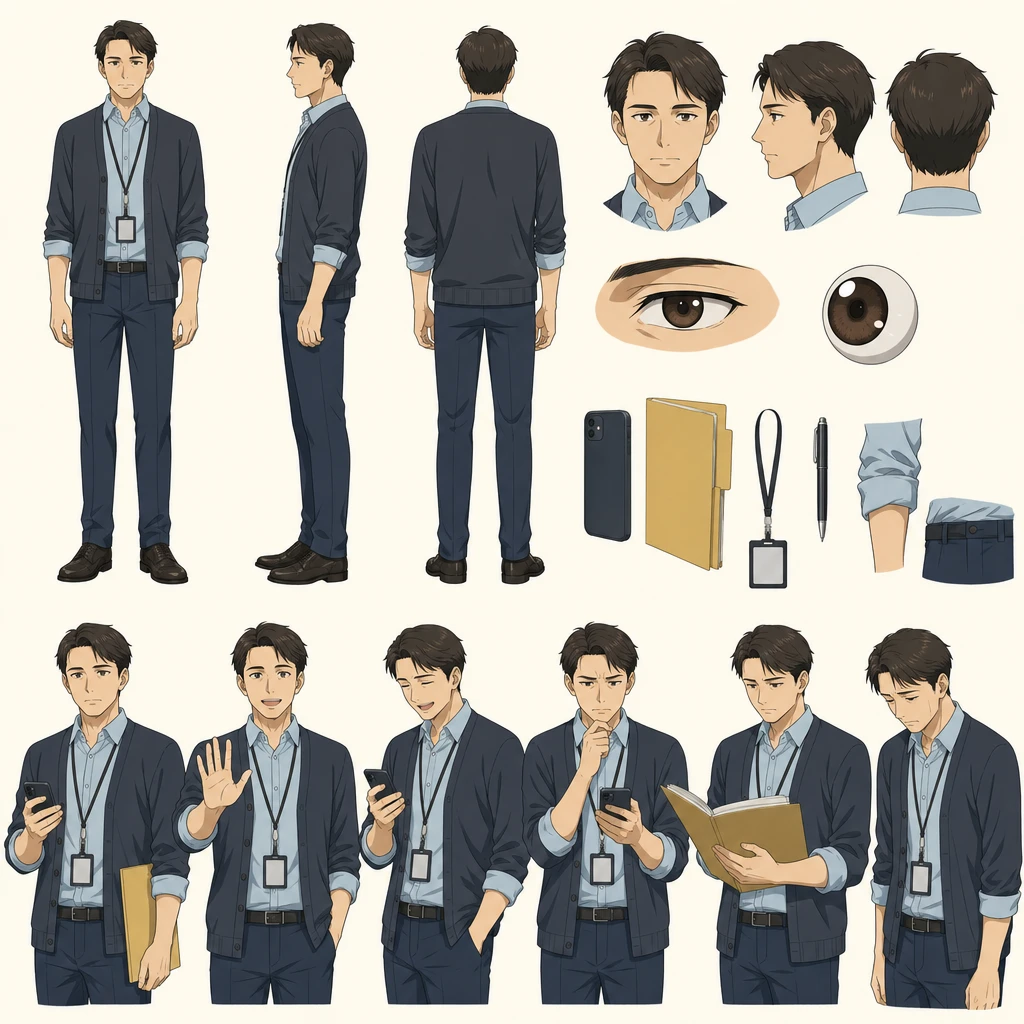
Sato’s decision embodies institutional risk, where public interpretation can outweigh private knowledge. His tired practicality shows how personal trust can coexist with an organization’s need to protect itself.
Direction as the through line
The production began as an imagined one-day hackathon and became roughly a month of work after the festival deadline was extended. The first plan treated each story beat as a prompt and generated one video per beat. It failed because a beat is not a shot: its information, emotion, perspective, timing, and rhythm must be divided across deliberate images.
An early AI-written screenplay draft was clean and logically formatted but emotionally empty, requiring substantial rewriting. Text-only shortcuts and rough 3D solutions also reduced pacing and visual depth. These failures clarified that the storyboard was not merely an input image for a model; it was where shot intention, eyelines, staging, and visual information were decided.
The end-to-end animatic then became the single source of truth, containing preceding and following shots, duration, pauses, and performance intention. Generated material could serve the shot, while clean plates, manually built screen graphics, compositing, and finishing handled exact wording, timing, and continuity.
Prompts, plates, keyframes, and video models operated inside decisions established by the screenplay, storyboard, and animatic. The tools expanded iteration; the production documents supplied judgment, acting, rhythm, continuity, and responsibility for the frame.
Returning to 5RPS
Tegaki is complete, and the production has now returned to 5 Requests Per Second. The short remains a finished experiment in how a small team can combine generated material with conventional direction and finishing while keeping authorship decisions visible.
For the fuller account of the earlier feature screenplay, the nested film structure, the failed first workflow, and the decisions that led to the final animatic and edit, read the full director commentary. The commentary preserves the personal and detailed production record behind this more formal archive summary.